You’ve seen the headlines this year. Culver’s, Texas Roadhouse, and Nothing Bundt Cakes are opening hundreds of new locations. Wendy’s, Papa John’s, and Pizza Hut are closing hundreds. Jack in the Box, Red Robin, Denny’s, and Red Lobster have trimmed their footprints, too.
The easy explanation is the economy, menu fatigue, or private equity. Those factors likely play a role.
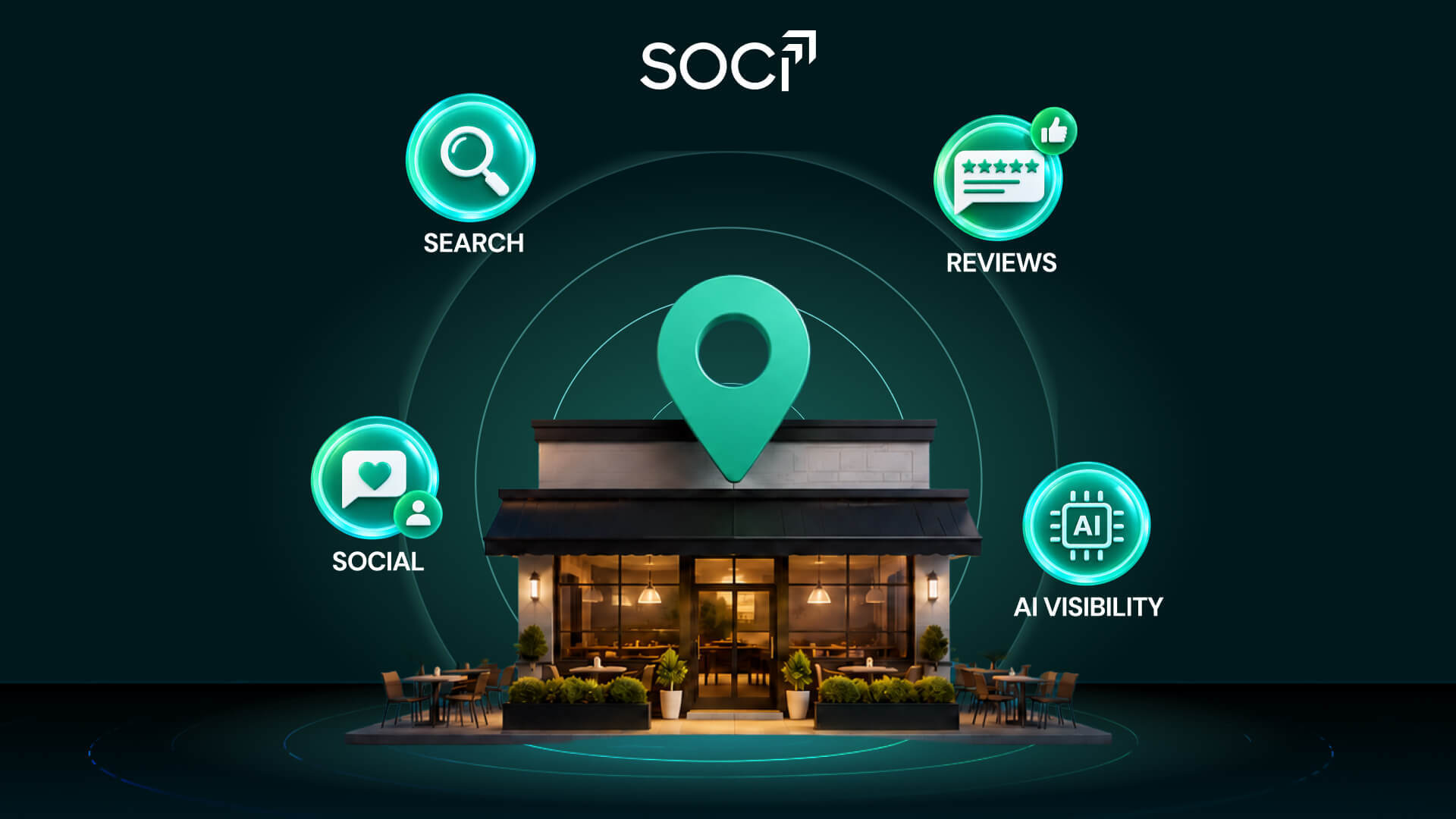
But when we analyzed Local Visibility Index (LVI) data comparing eight expanding restaurant brands with eight contracting ones, we found something missing from most of that coverage: a consistent, measurable gap in how these brands show up online across every channel that drives local discovery: search, reviews, social, and AI.
This isn’t a claim that a Yelp rating directly causes a store closure. It’s something more useful for marketers: a real-time signal.
The same digital fundamentals reflected in a company’s local visibility data appear to move in step with the fundamentals driving its real estate decisions, often before the story reaches the trade press.
The LVI score is SOCi’s composite measure of a brand’s local digital visibility, combining performance across search rankings, review sentiment, social engagement, and AI recommendation rates into a single 0–100 score.
In this analysis, the gap was clear before we broke it down by channel. Growing restaurant brands averaged an LVI score of 61.4, while shrinking brands averaged 46.6 — a 14.8-point gap that appeared consistently across every underlying channel.

The AI gap is the widest, and the newest
The most striking finding is also the most forward-looking. Expanding chains are recommended by ChatGPT in about 20% of tested queries, compared with roughly 3% for contracting chains — a 6–7x gap. Gemini and Perplexity show the same pattern, and expanding brands earn meaningfully higher AI-assigned star ratings across all three platforms.

AI is no longer a marginal discovery channel.
As SOCi’s 2026 Local Visibility Index found, AI recommendations are highly selective. Only about 1–11% of brand locations are recommended across ChatGPT, Gemini, and Perplexity, compared with 35.9% that appear in Google’s traditional 3-Pack.
Earning a recommendation requires a higher standard of data accuracy, reputation, and differentiated content. Expanding restaurant brands appear to clear that bar. Contracting brands largely don’t.
Search and reputation tell the same story
The AI gap doesn’t exist in isolation. It’s built on the same local search fundamentals that have long mattered:
- Search visibility: Expanding chains appear in Google’s 3-Pack for 35.3% of tracked searches, compared with 14.4% for contracting chains. They also earn Yelp’s top organic ranking nearly twice as often (55% vs. 29.3%).
- Reputation: Expanding brands average a 4.39 Google rating and a 3.65 Yelp rating, compared with 3.82 and 2.49 for contracting brands. The Yelp gap alone exceeds a full star. Expanding brands also respond to 72.4% of Google reviews, versus 43.6%, and do so two to three times faster.


Review response rates are worth pausing on because, unlike star ratings built over years, they’re a lever marketing teams can pull today. The gap is one of the clearest signs that expanding brands treat local reputation as an operational discipline, not just something they monitor.
Social shows the biggest multiple of all
Expanding brands earn a 3.45% local social engagement rate. Contracting brands average just 0.13% — a roughly 26x gap. Expanding brands also have about five times more local followers on average.

The takeaway isn’t “post more.” Volume alone doesn’t explain the gap.
Expanding brands are building real local audiences with content that resonates in each market instead of pushing the same corporate post to every location page — a tactic often called waterfall posting. SOCi’s broader LVI research found localized content is a stronger driver of engagement.
What this means for your brand
Digital visibility alone won’t turn around a struggling chain. This data doesn’t claim otherwise.
But for multi-location marketers, the pattern among brands expanding in 2026 offers a useful gut check: they treat local search, reputation, social, and AI visibility as one connected system rather than four separate to-do lists.
- Treat data accuracy as infrastructure, not a one-time cleanup. Every channel in this analysis depends on complete, consistent business data across Google, Yelp, Facebook, and your local pages. It’s also the first thing AI platforms check.
- Systematize review response. Response speed and coverage — not just star ratings — separated the two groups. It’s also one of the few levers a marketing team can move in weeks instead of years.
- Localize your social content. Five times the followers and 26 times the engagement don’t come from posting more corporate content. They come from creating content that’s relevant to local audiences.
- Check your AI visibility specifically. Strong search performance no longer guarantees AI recommendations. If you haven’t tested how your brand appears in ChatGPT, Gemini, and Perplexity, you may be missing one of the biggest blind spots this analysis uncovered.
Want to see how your brand’s local visibility compares to the brands in this analysis, and to your category overall? Request a free LVI Brand Audit to get your Search, Reputation, Social, and AI scores benchmarked against your industry.
https://searchengineland.com/why-growing-restaurant-chains-win-at-local-search-and-ai-visibility-486656