
Google Search Console’s new Platform properties went live for our YouTube channel on July 7. On the first day alone, we recorded 18,233 impressions from Google Search. Eleven days in, the running total passed 200,000.
Clicks across those 11 days: 87.
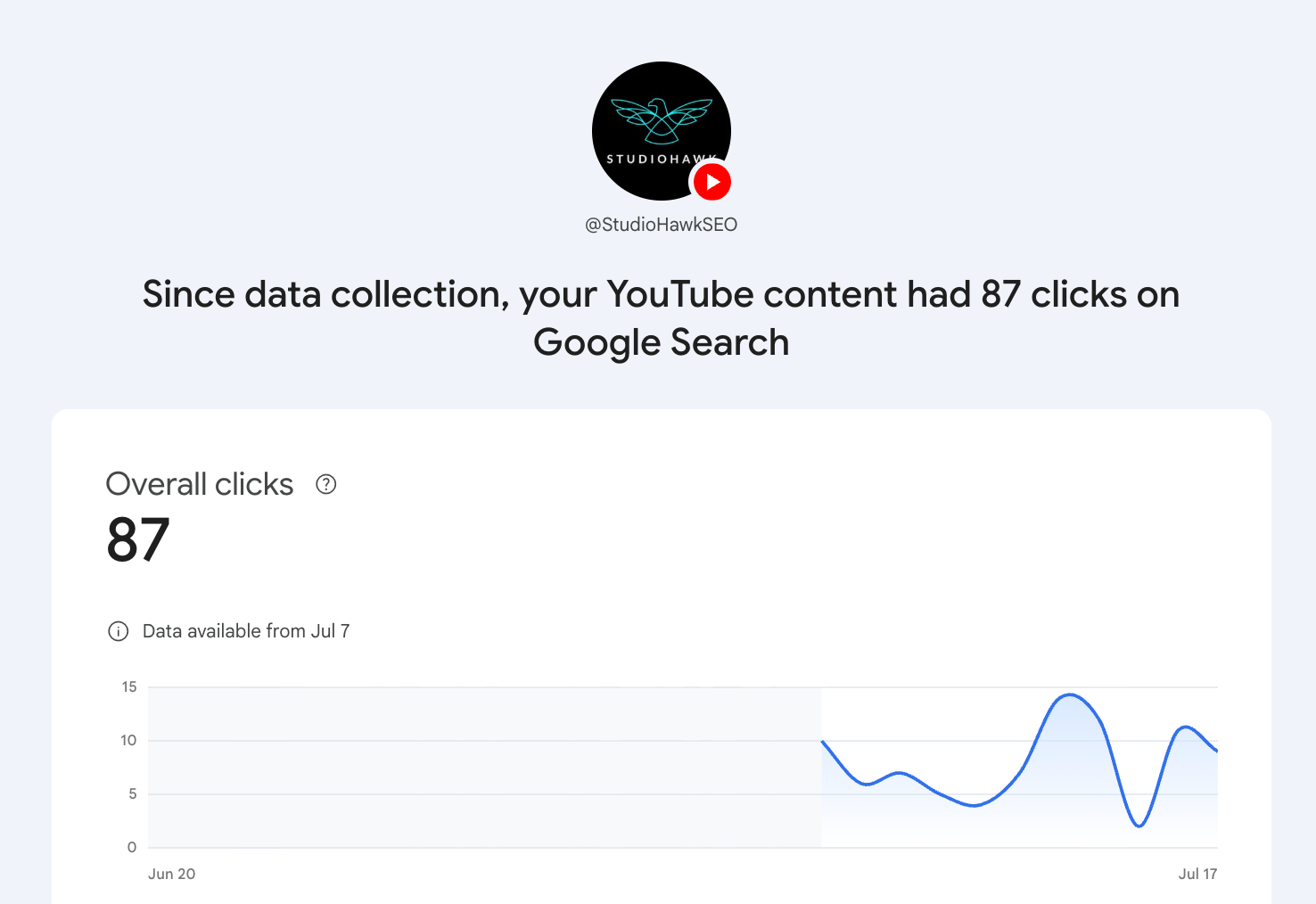
Extrapolate that run rate across a year, and it’s 6.7 million impressions and roughly 2,900 clicks we had never seen before. That gap is the single most useful thing the new report shows.
Google already considers the channel eligible to appear for roughly 18,500 searches a day. Now you can see all of it, and it changes how social and video content should be planned.
What launched and why it matters more than it looks
No one briefs a YouTube video to rank on Google. Content creators optimize for views, watch time, and subscribers, while search sits in a different workstream. Titles, thumbnails, and hooks aren’t a natural SEO play, though they share some principles that optimize for clicks.
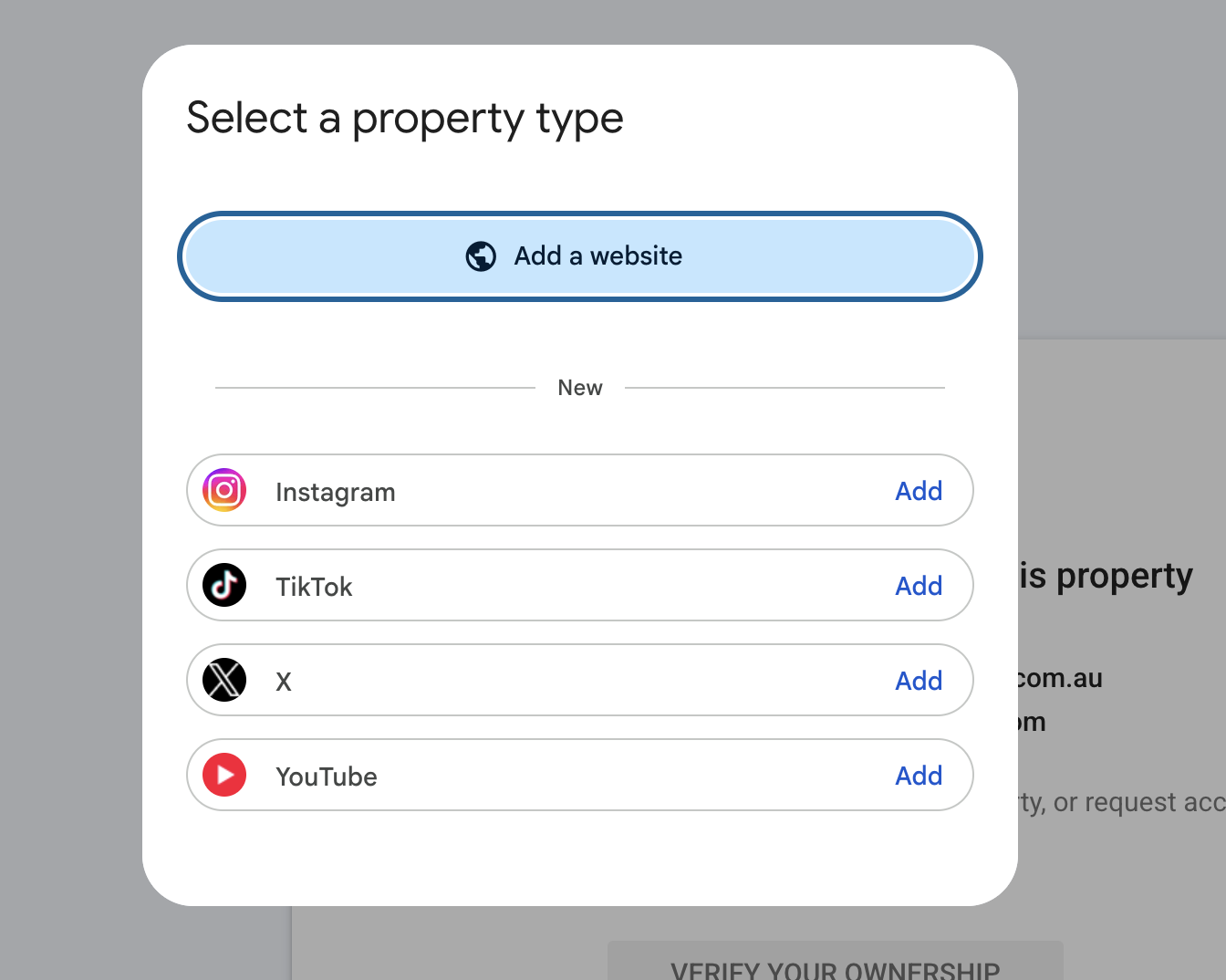
On July 7, Google’s Moshe Samet announced platform properties in Search Console. Connect a YouTube channel, Instagram profile, or TikTok account, and you’ll see the Google Search queries where that platform’s content appears, along with impressions, clicks, and positions.
On its own, that’s a reporting feature. The reason it matters is what Google is doing at the same time.
AI Mode is increasingly multimodal. It reads images and video directly, fans out queries from them, and assembles answers from multiple formats as first-class results, not decoration beneath the blue links. That means one query can give a brand several placements at once: a page, a video, an image, and a social post.
A brand publishing only text competes for one slot. A brand mapped across formats can hold several on the same results page.
Track, grow, and measure your visibility across Google, AI search, social, local, and every channel that influences buying decisions.
What the first 11 days of data showed
We connected our agency’s YouTube channel on launch day. Three findings got me theory-crafting and rethinking how I plan organic.
- Cluster demand is invisible as single queries: The export showed 149 distinct phrasings of “enterprise seo” totaling 31,555 impressions in 11 days. The exact phrase sits at position 10.7, one nudge off page one. No single variant would survive a keyword shortlist. Together, they are one of the channel’s biggest demand pools.
- Page-one eligibility nobody planned: Videos we never briefed as search plays are sitting on page one, outperforming our own website on the same queries. Google positioned them anyway.
- Search eligibility is a channel property, not a lucky-video property: Eighty-three separate videos earned web search impressions in the first 11 days. The top 1,000 queries produced 149,220 impressions and 10 clicks. The footprint is wide and shallow, which is exactly what “eligible but not packaged” looks like at scale.
Then we compared surfaces. Same queries, same 11 days: our YouTube channel against our own website.
| Query | Video position | Video impressions | Website impressions | The video ranking |
|---|---|---|---|---|
| ai search | 7.6 | 7,026 | 1 | What is AI Search? (The New SEO in 2026) |
| what is a sitemap | 4.4 | 3,863 | 0 | What Are Sitemaps & How To Utilise Them For SEO |
| enterprise seo | 10.7 | 3,226 | 1,470 | Enterprise SEO Strategies For Maximum Growth |
| seo specialist | 28 | 4,953 | 3,622 | SEO Specialist Skills That Most People Don’t Know About |
| keyword research | 20 | 3,224 | 36 | Keywords No Longer Work the Way You Think in 2026 |
The videos are not duplicating the site’s visibility. They are earning visibility the site doesn’t have.
“The SEO Specialist Skills” video is a 2023 upload that earned 45,785 impressions across all its queries during the period, making it the channel’s single biggest search footprint.

If your channel has been active for a year or more, you almost certainly have the same shape of data waiting — real query demand your social content is already surfacing for, invisible until now.
It’s worth being precise about what this data is.
- YouTube Studio shows YouTube Search: What people typed inside the platform.
- Platform properties show Google Search: The queries where your videos appear on the search results page.
Different populations, different intents, and the second was a black box until July. Instagram and TikTok analytics have the same blind spot, and you can integrate those, too.
Traditional search playbook on a social channel
Our early videos were unapologetically low production. Filmed at home, with no real setup, they showed me on camera walking through tasks like editing an htaccess file.

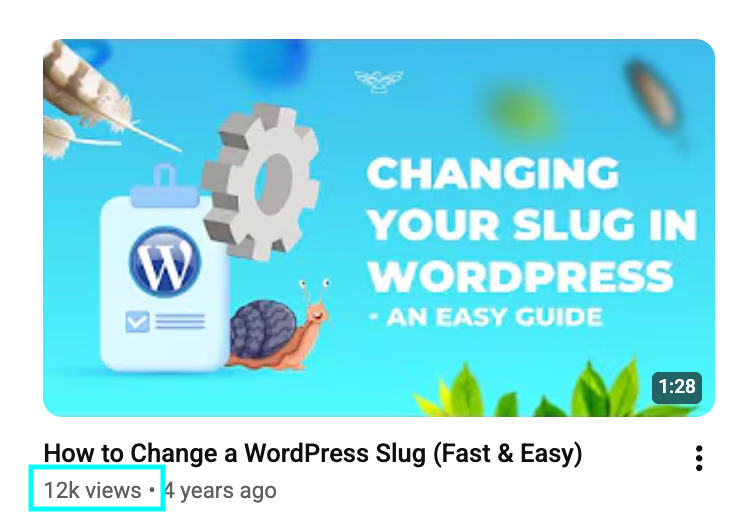
My theory was simple: Find top-of-funnel queries and make a video that answers them. “How to change your slug on WordPress” got exactly that, no frills. I briefed videos the way I briefed pages back in 2021.
We took a break. We got busy. Then, in 2026, we relaunched the channel using the opposite playbook: the YouTube meta.
Study similar-sized channels, find the outlier videos (the ones doing five or 10 times a channel’s normal numbers), and make a better version.
Like the classic Skyscraper method, but for video.

In that playbook, packaging comes first: the title and thumbnail are locked in before anything is filmed. The first 30 seconds are scripted to promise, prove, and preview; and the body is built with retention loops so there’s no clean exit point.

Thumbnails are a serious game, too. Even the facial expression you make affects performance. The meta also runs on repetition, or “reps.”
We uploaded consistently for months, gaining single-digit subscribers per video until the algorithm figured out who the audience was and distribution flipped. Our newest upload reached 2,300 views in nine days, several multiples above videos from three months earlier.
Broad top-of-funnel topics win that game. Then the platform property data exposed the other scoreboard, and our own 12-month analytics confirmed it.
The top content table is still dominated by the old search-first videos. A 2023 walkthrough of 301 redirects leads with 3,105 views, and how-tos on htaccess files, WordPress slugs, and robots.txt from 2021 through 2023 fill seven of the top 10 slots, nearly all paired with articles written two or three years ago.
Only two videos from the 2026 relaunch crack that list, though the newest one reached third place in nine days.
The clicked videos report tells the same story on a smaller scale. “What is AI Search?” leads with eight clicks, and “Keywords No Longer Work the Way You Think in 2026” earned five, both from the relaunch.
Between them sit the old guard: the January 2023 htaccess how-to with six, the 2022 WordPress slug walkthrough with five, and “SEO Specialist Skills” with three. Even the channel page itself earned four clicks nobody planned for.
One of those clicks came from the query “.htaccess wordpress.” Looking back at the home-filmed video, and cringing at the quality, it’s still converting searches years later.
The feed rewards packaging, breadth, and consistency, and pays out fast. The SERP rewards matching a query and staying relevant to it, and pays out for years.
Our top content in terms of views and watch time was created more than 12 months ago (highlighted in blue):

A channel that only plays the YouTube meta leaves the search game unplayed. The social topical map is how you play both on purpose.
The framework: A social topical map
SEO teams have used topical maps for years. The short version: stop chasing keywords one at a time.
Map every subtopic and question a subject contains, cover the map completely, and the engine starts treating you as the authority on the entire topic.
Social teams, meanwhile, have run content calendars by platform. The two have never shared an evidence base.
The fix is a framework I’ve been calling the social topical map: the topical authority and coverage playbook SEO teams have refined for years, applied to social and video content, and built from the platform property data Google just handed us.
One map drives content across YouTube, Instagram, TikTok, X, and LinkedIn. These are the six steps.
1. Connect your platform properties
In Search Console, add each platform account you control as a property and verify it.
2. Audit what Google already surfaces
Export the query data once you’ve collected a few weeks of it. First, group phrasings into clusters before judging anything. Our “enterprise seo” cluster looked like nothing as individual queries and 31,555 impressions as a group.
Then triage every cluster into one of three moves:
- Optimize: Roughly positions four through 20 with real impressions. The content is close. The packaging is losing the click. Rework the title and thumbnail before you make anything new.
- Embed: The asset already answers well. Place it on the matching page of your site so the page and the video hold the query together.
- Produce: Real demand, weak or absent position. Our “seo specialist” cluster at position 28 with 4,953 impressions is a brief for new content with a different angle, “What do SEO specialists need to know in 2026,” for example.
3. Build the map
Combine three inputs: the platform queries from Step 2, standard keyword research, and Google Trends for direction.
Organize the output by topic cluster, not by platform. Each cluster gets its demand evidence, dominant intent, and the formats that fit it.
This is the structural change. The seed of planning becomes the topic, and platforms become distribution channels for it.
4. Produce format-matched content
Match format to intent within each cluster.
- Comparison and evaluation intent suits long-form video.
- Quick how-to intent suits short-form.
- Data-led topics suit carousels and threads.
One cluster produces several assets across platforms, all pulling toward the same demand instead of five teams guessing separately.
The fan-out gives you the split: the topic is the blog pillar, a facet is the long-form video, and a sub-facet is the short, cut from the video you already made.
Here’s an example using creatine.
| Topic | Key facet | Sub-facet | |
| Query | “what is creatine?” (benefits, dosage, safety) | “when should you take creatine?” | “can I take creatine at night?” |
| Format | Blog article | YouTube long-form | Short / Reel |
| Note | The pillar. Covers the whole topic on one page. | One angle of the topic, explored properly on video. | One specific question, answered in 40 seconds or less. |
| Title / hook | Creatine: What It Does, Benefits, Supplements & Safety | You’re Taking Creatine at the Wrong Time (Here’s How to Fix It) | “99% of people don’t know when to take creatine, and it’s not the time you think” |

5. Embed on the matching site pages
Embed the video on the site page targeting the same cluster.
The page and the video now reinforce each other for the same queries, and you’re assembling the multi-format presence the SERP is starting to reward.
This is the article-video pairing we ran on instinct years ago, formalized. The pairs we built back then are the videos still topping our analytics today.

The goal state is multiple placements on one results page: your page, your video, your image, and the AI answer drawing on all of them.
Each new placement also generates new query data in the platform property, which feeds the next revision of the map.
6. Dominate
Hold multiple placements as text, video, and social results for the same topics. The query data compounds, so you go back to Step 2 and repeat the cycle.
The honest caveats
The rollout was gradual. Some accounts couldn’t connect properties. Google rolled out the feature globally just two days ago.
Week-one data is thin. Our first week looked like noise. The clusters only became visible after a month. Give it 28 days.
Platforms differ. YouTube data is the richest by far. Instagram and TikTok footprints in our account are smaller and skew toward navigational intent.
Impressions are not traffic. An impression with no click is an eligibility signal and a packaging problem. Treat this as a planning input for how to maximize your content’s performance.
Masking the click loss or finally measuring it?
There’s a fair criticism of this report: A giant new impressions number is a convenient way to dress up the decline in clicks as AI answers more queries on the search results page itself.
I half agree. But the click decline isn’t new.
Zero-click has been the reality for years. What changed is that we can finally measure another part of the search ecosystem. Until now, the website was the only surface we could see in Search Console, so it became the only surface we treated as SEO.
That’s the shift this data confirms. SEO extends beyond the website to every platform where Google can surface your content.
The social topical map helps you plan for that reality by connecting your website, videos, and social content to the same search demand.
Our channel was eligible for 203,000 Google Search impressions in 11 days and packaged for almost none of them.
Yours is probably in the same position. Now that you can see the queries, it’s time to plan like it.
https://searchengineland.com/seo-social-topical-map-484018