
If you ask ChatGPT to recommend a product, it’ll show you a carousel with eight product options.
In a March 2026 study, Tom Wells examined where these products originate. Out of more than 43,000 products, 83% matched Google’s top 40 organic Shopping results. For Bing, only 11% matched, and almost all of those were also found on Google.
The products AI shoppers see don’t come from the open web, your product detail pages (PDPs), or your reviews. Instead, they’re pulled from a single file most brands haven’t checked since setting up paid Shopping: your Google Merchant Center feed.
With AI shopping, your products’ visibility depends on the quality and accuracy of your feed. Your product detail page has taken a back seat. Your feed is now the real star.
The product feed decides which items show up first
ChatGPT builds its product carousel using shopping query fan-outs. These queries are separate from the search queries that generate the answer text.
Wells found that one of these queries often pulls a single page of Google Shopping results to populate an eight-product carousel, and 60% of strong matches come from the top 10 Shopping results. The order of products in the carousel matches their ranking in Google Shopping. Wells isn’t the only one seeing this.
Profound reviewed more than 1 million ChatGPT shopping offers in June, with an even more striking finding: Of the product citations ChatGPT pulled directly from merchant feeds, about 99.9% appeared as the top product offer.

The share of feed-sourced retrievals also grew from 4.3% to about 20% of all ChatGPT shopping retrievals in just six weeks. The reason is completeness.
In Profound’s data, feed-sourced offers populated brand, product image, and merchant details 100% of the time, compared with 0% for page-scraped offers. They also carried ChatGPT’s “best price” tag 100% of the time, compared with 21% for page-scraped offers.
The feed provides the LLM with clean, structured fields rather than forcing it to infer that information from the page.
Malte Landwehr of Peec AI, whose data supported the Wells study, shared that he added a new shop to Merchant Center and saw it appear in Google Shopping the next day, then in ChatGPT. If you connect your feed, your products can show up.
Skip it, and you might go invisible.
See where your brand appears in AI search, where competitors are winning, and what it takes to become the answer AI recommends.
The real catch and what it means for your PDP
Most advice about optimizing for AI leaves out an important detail.
According to Profound’s analysis, about 88% of ChatGPT product offers still come from web product detail pages rather than feeds. Even for merchants already using feeds, around 76% of offers still came from the page. This means the feed doesn’t replace the PDP.
The feed helps with ranking, but most offers still come from the PDP.
Your catalog serves two main purposes.
The feed determines whether you’re included in the selection and where you rank. The PDP is where you convince shoppers to buy and gather reviews and coverage that influence how AI models talk about your brand.
However, getting coverage alone doesn’t guarantee you’ll be chosen. When Lily Ray studied brands that ranked themselves No. 1 in their own listicles, about 69% were cited but not recommended.
Instead, the top spot often went to a larger competitor on the same list. These “ghost” rankings are where your content is used as the source, but someone else gets picked.
On-page structure alone isn’t enough for AI shopping.
In June 2026, our team analyzed 11,400 AI shopping answers across ChatGPT, Perplexity, and Gemini. We found that category structure didn’t affect whether AI recommended a brand on any platform.
Optimize one surface using the other’s playbook, and you’ll underperform on both.
Agencies are already reorganizing around this. As Andre de Gaye, sales director at Charle, put it:

His team is “moving away from treating SEO and feed management as separate silos.”
What agents actually read
An AI shopping agent doesn’t browse your site the way a person does. It reads structured attributes and product details.
OpenAI explains that product results are organic and unsponsored. They’re ranked by relevance using signals such as “availability, price, quality, and whether a merchant is the primary seller.”
These signals come from catalogs and feeds, not on-page copy. The catalogs now include major retailers like Target, Sephora, Nordstrom, Best Buy, The Home Depot, and millions of Shopify merchants.
The non-negotiable core is the data Google Shopping has always rewarded: a valid GTIN, an accurate title, price and availability that match your live site, a clean image, brand, and the correct product category.
Get those wrong, and nothing downstream matters.
Google continues to add to these basics. In July, it started supporting the product category property, which includes both Google’s taxonomy and your product types in merchant listing structured data. Sale duration fields were also added.
The number of signals agents can read about a product keeps increasing, and all of them come from the feed.
At Google Marketing Live 2026, Google added another layer by introducing conversational attributes to the Merchant Center product data specification.
These optional fields are meant for AI features like AI Mode and Gemini. Google lists:
- Question and answer: Structured Q&A pairs. This is a great starting point because it lets you answer questions like “Does this work for air travel?” before the shopper asks.
- Related product: Defines relationships using types like
often_bought_with, required_part,accessory, andsubstitute. This helps an agent suggest a complete solution instead of a single product. - Document link: Lets you include supporting PDFs, such as manuals, spec sheets, or sizing guides.
- Item group title and variant option: Connects variants to a product family and matches queries like “Show me this in black, medium.”
- Popularity rank: A score showing how a product performs against the rest of your catalog, so a model can answer questions like “What’s your best-selling running shoe?”
None of these affect whether your product is approved.
They’re all optional enhancements that let you provide information that previously lived only on the page or in a PDF a model couldn’t always read.

Hidden feed problems that reduce your visibility
For most brands, the main challenge isn’t strategy. It’s keeping everything updated and well maintained.
In Google Merchant Center, common problems include missing or incorrect GTINs, image issues, and shipping or price details that don’t match your website. If a product is disapproved, it won’t just rank lower in AI shopping results.
It won’t show up at all.
The most harmful gaps are often the ones that don’t trigger any errors.
- Titles that are too generic or template-based often miss details shoppers care about, such as material, use case, compatibility, or size.
- Boilerplate descriptions make it harder for a model to extract detailed information.
- If variant data is missing, searches for terms like “black, medium” won’t return any results.
- If your pricing isn’t clear or can’t be read by AI, it won’t help. Previsible looked at 6.77 million AI-referred sessions and found that “contact us for pricing” gives AI nothing to compare or recommend.
- If your availability information is out of date, AI might recommend products that are no longer available.
This problem is easy to measure.
Product detail pages scored only 63.5 for AI citation readability, even for top retailers, according to Adobe’s Q2 AI Traffic report. That’s much lower than their homepages and buying guides, which scored in the low 80s.

The pages containing the product data AI needs are often the hardest for machines to read. Each missing detail acts as a silent filter.
Your product might be approved and indexed, but it can still be invisible when someone searches in natural language.
This is where customers decide to buy
If AI shopping were still a minor trend, there’d be no hurry. But things have changed.
The same Adobe report found that traffic from AI sources to U.S. retail sites grew by 393% year over year in the first quarter, and by December, it was up more than 1,150%.

By March, AI-referred traffic converted 42% better than non-AI traffic, while a year earlier, it converted at only about half that rate.
Salesforce also reported that about 20% of global online holiday sales — roughly $262 billion — were linked to AI and agents.
AI-referred traffic converted at about eight times the rate of social traffic. AI platforms are now bringing shoppers who are ready to buy to retail sites.
The key question is: Are your products being recommended?
How to see if your product feed is ready for AI
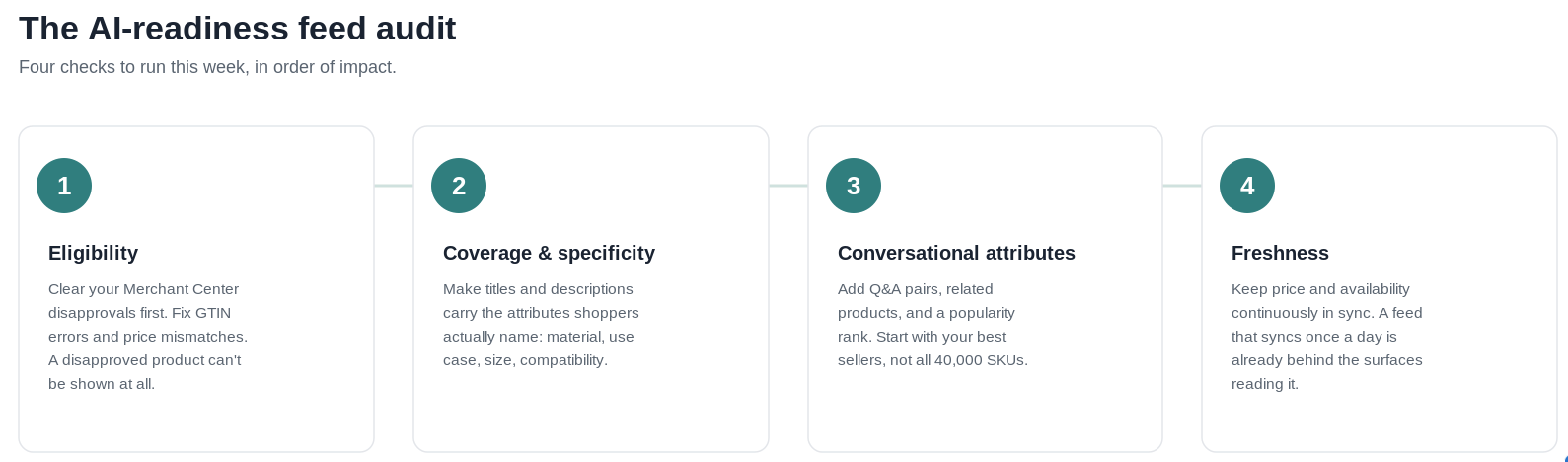
You can check your product feed this week. Focus on these four areas.
Eligibility
Check your Merchant Center for disapprovals and diagnostics. Fix GTIN errors and price mismatches first. Any disapproved product can’t be shown by AI agents. This is the first requirement.
Coverage and specificity
Look at your top 50 revenue products and review their titles and descriptions as if you were an AI agent.
- Do the titles mention the features buyers care about?
- If the description just repeats the title, it doesn’t add value or help shoppers choose your product.
Conversational attributes
Begin by adding question-and-answer sections to your best sellers. Then link related products and include a popularity rank. Focus on the SKUs that already generate revenue. You don’t need to update all 40,000 items right away.
Freshness
Keep prices and availability continuously in sync with your live site. AI shopping surfaces refresh constantly, so a feed that updates just once a day is already behind.
If you follow these four steps, you may find the issue isn’t your strategy. Instead, your feed may have been set up for paid Shopping years ago and hasn’t been updated for discovery since.
The platforms are converging on the feed
Google’s Shopping Graph now holds 60 billion product listings, up from 50 billion earlier in the year.
Google has also worked with Shopify, Etsy, Wayfair, Target, and Walmart to create the Universal Commerce Protocol, which uses your existing Merchant Center feed for agentic checkout.
To opt in, merchants add a new native_commerce attribute to the feed and keep their product, offer, and review schema in sync. Miss it, and products are ineligible for AI-powered checkout.
As Jason Tabeling noted in July, Merchant Center is “no longer simply for Shopping ads. It’s becoming the primary source of product data for AI discovery.”
Meanwhile, presence on AI surfaces is decoupling from classic rankings.
A July study by SE Ranking found that only about 2.32% of advertisers appearing in Google’s AI Mode also ranked organically for the same search. Around 85% didn’t appear in organic results at all.
The old signals and the new ones are pulling apart. Kevin Indig explained the change clearly:
- “The last decade rewarded marketing arbitrage. Agentic commerce rewards product truth.”
The way people complete purchases is still evolving. For instance, Walmart tested checkout inside ChatGPT, but it converted at only about one-third the rate of Walmart’s own website.
OpenAI has also stopped offering its hosted checkout. Still, shoppers are already turning to AI for product discovery, and this shift relies on the product feed.
Track your visibility across AI search, uncover missed opportunities, and grow your presence where customers are asking questions.
AI shopping starts with your product feed
Traditional SEO is still important. But AI doesn’t pick the best-looking product page.
AI chooses the feed that answers shoppers’ questions before they even ask. It looks for information that’s accurate, complete, and written in everyday language.
Most brands haven’t touched that file since they set it up for paid Shopping. The brands that update it now will be ahead when everyone else catches up.
The next time ChatGPT shows a shopper eight products, ask yourself one question:
- Is your product one of them?
That all comes down to your feed.
https://searchengineland.com/ai-shopping-product-feed-page-484060