Key takeaways
|

The air in the email marketing world feels a little different in 2026. We’ve moved past the initial shock of generative AI and the scramble of new privacy regulations.
Now we’re in the era of refinement. Today’s subscribers are savvier and more skeptical than ever—they can spot obvious AI content from a mile away. Striking a balance between cutting-edge automation and human touch is crucial.
In this article, we’ll break down the tactical shifts you need to master this year—from advanced lifecycle strategies to the rise of “intelligent gatekeepers”—to ensure your email program remains your brand’s most powerful growth engine.
Let’s get started!
Table of contents
- Bring personalization to the forefront
- Design for the AI-gatekeeper
- Shift to minimalist and structured design
- Leverage annotation schema
- Become an email orchestrator
- Enhance the customer experience with AI
- Use AI beyond email copy
- Invest in specialized design and automation tools
- Integrate email tools and prioritize data management
- Optimize for accessibility and inclusivity
- The future of email
1. Bring personalization to the forefront
In order to connect with subscribers, messages in your campaigns need to be relevant, timely, and personalized. This isn’t just true for email campaigns; it’s true for every touchpoint in your marketing campaign.
Effective personalization rests on these pillars:
- Segmentation: dividing your audience lets you customize what and when you send.
- Dynamic content: creates ultra-personalized emails without the impossible task of building countless versions by hand.
2. Design for the AI-gatekeeper
One of the most significant changes in 2026 is that your subscribers aren’t the only ones reading your emails — AI is, too. Tools like Apple Intelligence and Gmail’s Gemini now summarize your content for the user before they even open the message. (This is a big contributor to why open rates are no longer reliable.)
This shifts the question email marketers need to ask. The question is no longer just “did my email land and look great?” but “did the AI surface the right topics in the summary?”
Take a similar approach to your emails as you do with SEO. Front-load your email content with keywords and ensure your most important value proposition is clear and easy for a machine to “scrape” and summarize accurately in the inbox preview.
If your email is image-heavy, include a thorough description in the alt attribute of your image tags. But none of these tips matter if you are just guessing how AI is going to summarize your email. Using tools that provide a preview of how your messages are summarized can help you tailor your messages accordingly.
In 2026, the most creative writer doesn’t win. The marketer who makes their content with the machines in mind will be victorious.
3. Shift to minimalist and structured design
You might have heard that humans have an 8-second attention span (shorter than a goldfish!). While mostly a myth—goldfish actually have excellent memories—the principle that users gravitate toward the quickest possible win still holds.
Move away from giant, text-heavy emails. Modern aesthetics are trending toward leaner builds that load faster and are easier for AI tools to interpret and summarize.
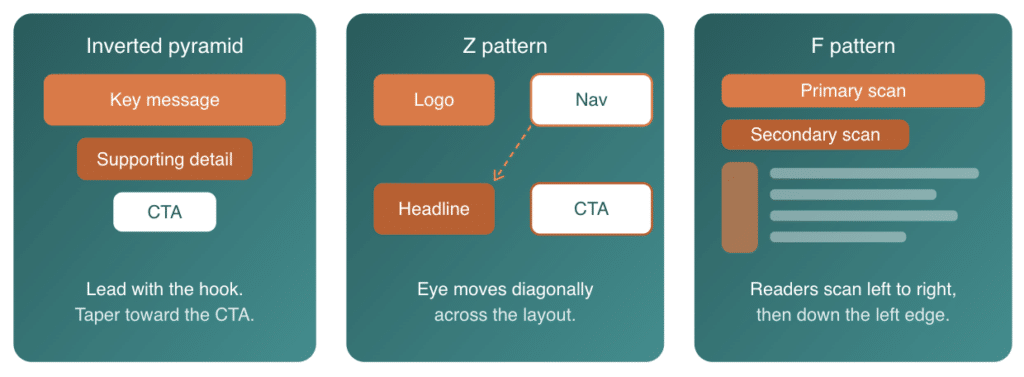
Facilitate reading by leveraging known structures for content hierarchy, like the Inverted Pyramid, or the Z or F-patterns. Use heading tags properly (H1 for section titles, not just big text) to signal to AI which information matters most.
4. Leverage annotation schema
Years ago, Gmail introduced support for structured data in emails—small code snippets using JSON-LD or Microdata that give mailbox providers richer information about a message’s content. This allows Gmail to render special UI elements directly in the inbox, like image carousels or a banner showing a discount code and its expiration date—features that appear exclusively for messages landing in the promotion tab.
While there’s no official confirmation that structured data feeds directly into Gmail’s AI summarization process, it’s part of the message body and is parsed by AI. At a minimum, structured data gives the AI engine meaningful, organized signals about your content. Since most senders still aren’t taking advantage of this, adopting it now is a straightforward way to get a leg up on competitors who haven’t made the move yet.
5. Become an email orchestrator
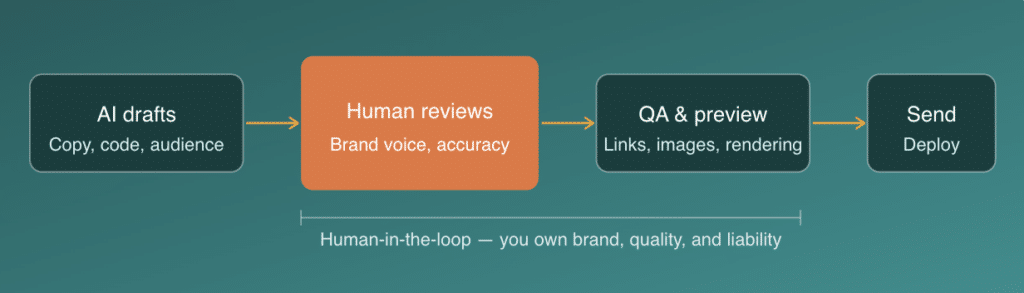
The role of the email marketer is changing; in 2026, you aren’t just a builder—you are an orchestrator. AI is taking over the heavy lifting of coding tables, drafting subject lines, building audiences, and interpreting results. You will be hired for your ability to manage that output.
With AI handling production, your primary job is quality assurance—making sure the automation doesn’t “hallucinate” or stray from brand guidelines. A “human-in-the-loop” approach is a great way to work with AI-generated content, often generating 40% higher quality.
Take time to review AI output in an email rendering preview, flag stakeholders when needed, and always check links and images. Delegate labor, never liability.
6. Enhance the customer experience with AI
The novelty of AI-generated copy has worn off. In 2026, the goal is to use AI to enhance to enhance the customer experience as subscribers grow more skeptical and ignore obvious AI content. Some examples we’ve seen work well include:
- Analyzing how your audience is reacting to your tone.
- Sharing personalized product recommendations based on customer data and interest signals.
- Optimizing send times to meet customers when they are most likely to engage.
- Tailored messaging for win-back campaigns.
Remember: Always edit AI outputs to ensure they feel human and aligned with your unique brand voice.
7. Use AI beyond email copy
Written content is the most popular GenAI output for marketers. However, there’s so much more you can do:
- Test, find, and fix rendering, code, and compliance risks.
- Generate on-brand copy and variants for subject lines, body, and CTAs.
- Monitor subscriber experience and deliverability so you can catch issues early, avoid surprises, and keep critical programs out of trouble.
- See how you stack up against competitors, where you’re losing attention, and what to change next, turning performance data into clear next steps.
8. Invest in specialized design and email automation tools
You need a dedicated email designer—ideally, one with the right tools for the job. As email continues to grow and develop into its own medium and remains one of the marketing channels with the highest return, specialization is essential.
Beyond having an email designer on the team, marketing teams should also take a hard look at their automation tools.

To speed up design and development: use templates, email building tools that cut development time, reusable HTML modules, and AI design tools for generating layout and style variants. For lifecycle gaps, lean on automation—a single automated email works far harder than one-off sends.
9. Integrate email tools and prioritize data management
Data management is a recurring obstacle, and it will only grow more critical as personalization demands increase.

Try using BriteVerify from Validity to validate addresses at the point of entry, protecting sender reputation from soft bounces. Then narrow your focus:
- Focus on one lifecycle phase at a time: re-engaging cold subscribers or recovering abandoned carts, for example.
- Audit what you have: data you own now, data you can easily get (preference centers, polls), and data you’d love to have (browsing history).
- Brainstorm personalization: match available data to your goal; working within constraints often sparks the best creativity.
| Customers vs. prospects | Personalized campaign ideas | Data you need |
|---|---|---|
| Customers who purchase products in multiple categories | Gift guide or come visit our store |
|
| Customers who have purchased one product but not a second | Product recommendations |
|
| Customers who have purchased 3+ products (your superfans) | Ask for a review or shoutout on social media |
|
| Prospects who have been on site browsing in the last 24 hours | Back in stock or “get it before it’s gone” |
|
| Prospects who haven’t engaged with an email in 30 days or more | Re-engagement campaign |
|
| Prospects who are so close to making a purchase | Abandoned cart or abandoned browsing |
|
Integrating your email platform with your CRM, CDP, analytics tools, and marketing automation unlocks more insights, better personalization, and clearer results. Even without a robust tech stack, signup forms, preference centers, and in-email polls can surface useful data.
10. Optimize for accessibility and inclusivity
Accessibility is now a legal requirement under the European Accessibility Act and similar laws—and it’s simply the right thing to do. Key best practices:
- High-contrast colors; font size 14 or larger
- No flashing GIFs or single-image email designs
- Semantic heading structure for screen readers
- Large, thumb-friendly buttons on mobile
- ALT text on all images
- Easy-to-find unsubscribe links
- Inclusive language throughout
Test before you send using tools for robust accessibility checks, including visual impairment filters, automatic checks for alt text, text justification, and table roles, and an NVDA screen reader preview. What your email service provider (ESP) offers is usually not enough.
Some email testing tools, like Litmus, have built-in accessibility checks. Reviewing your content before hitting send helps you maximize the impact of every email. Accessibility testing includes:
- Visual impairment filters to see what your email designs look like to people with different visual color deficiencies.
- Automatic accessibility checks that look for elements like alt-text, text justification, table-roles, and more.
- NVDA screen reader preview.
Check out this great session about email accessibility from Litmus Live 2026.
The future of email in 2026
The roadmap for 2026 is an interesting blend of efficiency and humanity. While we explore ways to use tools like automation and AI to work faster, we must prioritize humanizing our messages through inspiring personalized emails and accessibility.
- Verify your data: use BriteVerify to ensure your personalization is built on a clean foundation.
- Optimize for AI: make your content “scannable” for the intelligent gatekeepers summarizing your emails.
- Prioritize trust: focus on reply rates and authentic engagement over noisy, outdated metrics.
Get email insights from marketers worldwide
Dive into the State of Email Reports for the latest trends, innovations, and best practices across the email marketing industry.

The post The Litmus Team’s Top Email Tips for 2026 appeared first on Litmus.
https://www.litmus.com/blog/top-email-marketing-tips